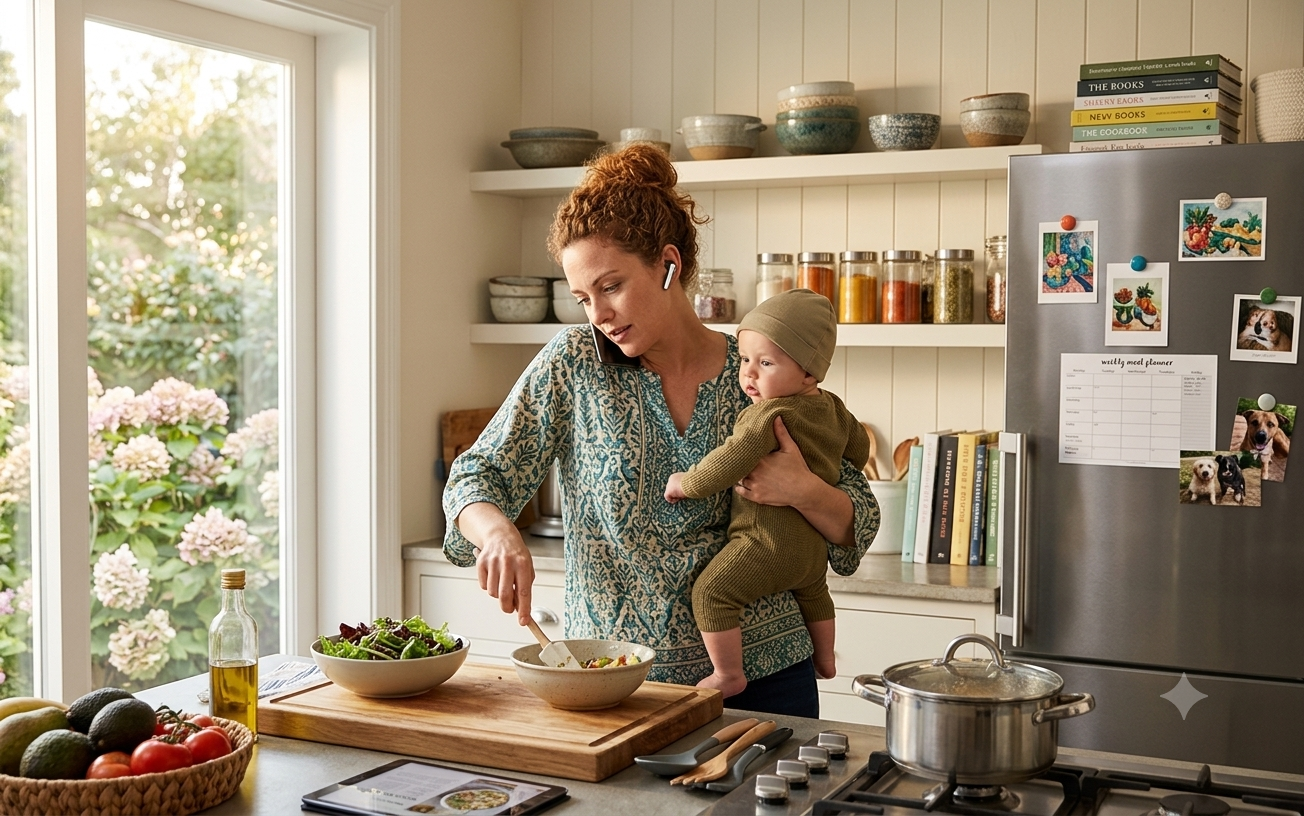
Of late, I have been seeing a lot of reels in which young girls promote the concept of “Trad Wives” (Traditional Wives).
What are Trad Wives?
Trad wives, or Traditional Wives, are wives who stay at home and take care of household chores like washing, cleaning, cooking, and caring for the kids. Well! Actually, the tasks of traditional wives are never-ending.
However, the social media influencers propagating this concept have taken it a step further by making bread from scratch (bread making using flour, etc.). It is not just bread, but several other items that are easily available in the market are made at home by them. They also talk about providing sex to their husbands as per his demands, irrespective of whether they want it or not. They talk of pampering their men and putting them on a pedestal. They spread the idea that men should be the breadwinners and women should not earn.
The glaring contradiction is that these very trad wives who are posting such content on social media are actually earning huge sums through brand collaborations, etc.
Trad wife influencers glamorize the concept by dressing up in dainty Barbie-like clothes and makeup. They post videos about how they take care of their homes, doing the laundry, feeding the kids, etc. Many posts use nostalgic imagery or music to make their videos authentic. They are trying to spread the message that the simpler times when women stayed at home were better than the struggle and difficult lives of career women.
The popularity of these videos shows that many people are either impressed by the concept or agree with it. Hence, it comes as no surprise that “trad wife” videos have garnered over 300 million views in recent years.
The concept started in the US and is spreading to other countries, impacting the minds of young girls who have started believing that this is a better way of life and they need not complete their education or get a degree.
Let us look at the history of traditional wives — and why the concept died in the past!
Years ago, gender-specific roles were that men went out to earn a living while women stayed at home and managed the home. This concept worked well because homes were not neglected and children received the love and attention of both parents, especially the mothers. This concept also made it easier for women during pregnancy and post-delivery when they did not have the burden of deadlines and the stress of work.
Over time, this concept led society to treat women as inferior to men. Men were treated as superior because of their physical strength, the fact that they were the breadwinners, and also because it was believed that they were somehow better because they could go out and work. Women led lives where they had to conform to their husband’s idea of a perfect wife, which put enormous pressure on them. The effect of this can be seen even today, where women try to be “people pleasers,” putting themselves and their needs last both at home and in the workplace.
Men were policymakers; they ran nations, and women were expected to abide by the rules created by men, which favored men. This led to severe legal, social, and economic inequality in society. Women were denied the right to vote, own property, or even access higher education. In fact, women could not even speak freely with others or in groups without the approval of men. In other words, women were treated as second-class citizens.
The feminist movement began in 1789 during the French Revolution, which witnessed organized participation of women. The movement grew with time. However, the phrase “feminist movement” was coined by Martha Weinman Lear in 1968.
The movement spread rapidly across the First World countries. Women started getting educated and joining the workforce; they were given voting rights, legal rights, etc. Women began to make their presence felt by taking important roles in government, corporations, and more.
On the face of it, it looked like women had finally broken the shackles and were in positions of power and their woes were over.
Not quite…
There was a new problem with this! The patriarchal society still considered men superior to women, and managing the household was and continues to be considered the woman’s responsibility. Women now had a double role to play, managing their homes and careers. In India, men were so clear about these gender specific roles that they openly told their wives that “the home is your first responsibility, your career comes after that.” Women were taught to prioritize their family and home over their careers.
The outcome of this was that career women were riddled with guilt that they were neglecting their homes. Society was always ready to point fingers at working women and judge them. Besides, there was disparity in the salaries given to men and women — men were and are paid higher salaries for the same role and job description.
The struggle of juggling two roles coupled with constantly being judged forced many women to give up their careers and opt to become housewives or homemakers, which in today’s day and age is glamorized as the “Trad Wife.”
The “Trad Wife” concept is catching on and becoming popular among girls who have seen their mothers struggle to manage two roles, often not doing justice to either. Probably these girls feel that taking up all those responsibilities is not worth their time and effort. So they would rather marry a rich husband and become a homemaker. The positive for the “trad wives” today is that they have nearly equal rights. Besides, they do not have to deal with workplace stress and can stay at home peacefully.
However, it is not as good as it seems!
The fact is that in countries like India, patriarchy is still prevalent and men are still considered superior to women. And, managing the home is considered a menial job. So, women continue to be treated like inferior beings. Men become the dominant partners, decision makers, and superior beings. Women in such households are expected to live by the rules set by their fathers, husbands, or sons.
In most societies, the worth of an individual is assessed by the amount of money they earn. And since a housewife/homemaker/trad wife does not earn anything monetarily for the job she does, she is considered “worthless.” This led many educated women at home looking for their identity to establish their worth by doing things so that they prove to themselves and others that they matter. I have seen this in many women clients who come from affluent families.
However, in India, in recent years there has been a slight shift in perspective. In educated households, Millennials and Gen Z men are increasingly recognizing their responsibility in managing homes, kids, etc. Women are highly educated and given priority in many organizations over men for certain job roles. Besides, organizations are also being more accommodating towards women. Also, in India, women can hire maids/nannies, etc., to help with the household chores and managing babies. In the internet era, the biggest positive for working women is the convenience of working from home.
I feel that working women in today’s world have it somewhat better than a few years ago.
Given these conditions, I wonder if becoming a “trad wife” makes sense? Why would anyone want to give up financial independence and being treated with respect to stay at home?
I write this article today because I was intrigued by these reels and what they are trying to convey. Initially, I agreed with the “trad wife” concept because I have been one myself!
But later I began to question the concept and my life choices!
Let me briefly give you a gist
I completed my Instrumentation Engineering degree in 1990. I was a very ambitious woman and wanted to rise the corporate ladder. I had been a very good student and had done extremely well in my studies, but like any other woman of my generation, I was given the mantra of “family first.” I did not question it because that was the norm. So, I refused a job transfer just to stay with my husband and his family. Fortunately for me, I was able to get a better job in the same city. I loved my new job. All was going well, and then I had my son.
And like any career woman, I was at a crossroads as to whether to work or stay at home. This time, everyone around me left it to me to decide what I wanted to do. My husband told me that he would support me in whatever decision I made. But I was a person who would feel guilty about leaving my baby at home and going out for even a couple of hours. I realized that if I went to work, I would be unable to do justice to either role. I felt that the company could easily find a replacement, but I am the only mother for my son. So, I decided to put family first and gave up my job. I started pursuing my MBA hoping that I could work after my son started schooling. I completed my Diploma in Management and soon had my daughter. We then moved to Dubai, and I couldn’t complete my MBA.
In Dubai, I was a full-fledged “trad wife”, taking care of home and family. Initially, I was very busy with the kids and didn’t know how the days just passed. But that phase was soon over and my children had school the entire day, my husband was working the entire day, and I was at home with nothing much to do. Housework was easy in Dubai because we had all the modern gadgets for managing housework with the added facility of house help.
Being well-educated and a career woman, activities like parties, traveling, shopping, etc., did not fulfill me. I always felt a vacuum. I tried working but could not fit into the workplace. I often felt that I was wasting my life. Many people pointed out to me, “What is the use of becoming an engineer? You are not working anyway?” Or, “You have deprived someone else of an opportunity to become an engineer and wasted your degree.”
The harsh reality is that society assesses the worth of an individual based on how much money they make! And, you could be working very hard, physically and mentally, but if that does not bring you a salary, you are “worthless.”
However, for me it was not about the money or the opinions of others; it was more about what I thought about myself. Unfortunately, I didn’t think very well of myself because I felt I was not doing anything much.
I have a lot of respect for housewives, especially since I have been one myself. But I feel that they do not get what they deserve. Not just men or strangers, even other working women look down on housewives or “trad wives.”
I had somehow come to terms with my status until we returned to India and both kids went to their universities. There was a strange kind of emptiness. I spent the entire day doing nothing. I had no kids coming home to me, only my husband late in the evening. This emptiness made me restless. This is when I decided to do something!
I completed my PG Diploma in Management and started working in an IT start-up as a content writer. I was hired as a fresher because I did not have any relevant experience. But I worked with dedication and rose in my career. I quit my job after two years, but this time to work as a freelance writer. The “housewife” in me had not left me; she wanted to be at home and do something constructive. And so I started working as a freelance writer. I became an author subsequently. I kept up-skilling regularly, completed my life coaching certification and other courses.
This is my experience as a “trad wife”. I have no regrets, and I believe that, thanks to my husband, I have led a life of choice, worked when I wanted to, and stayed at home when I felt like.
However… if I look at the conveniences young working women have in India today, I would love to trade my life for it!
To become a trad wife or not is an individual decision. But I believe it should not be taken impulsively or based on what someone else is doing because each of us has our interests and needs, and those need not be what an influencer is doing on the screen. It is best to weigh the pros and cons of both and choose what is best for you.
It is ultimately about how you look at yourself and whether you respect yourself. Trad wives need to be cautious about this. While they may enjoy taking care of the home and family, they should ensure that they are not disrespected or taken for granted by their husband or kids. After all, the feminist movement started to give an equal status to women. And, if you lose that, you are going back by 100/200 years.
After all, you only live once, so make the most of your life!